Chapter 5
About AfA e.V.
Who we are, why we inform — and how Germany’s Afghanistan deployment is being reviewed.
The withdrawal of American troops on 31 August 2021 did not mark the end of the tragedy that has been unfolding in Afghanistan since April 1978. The Taliban’s renewed seizure of power carries the risk of a humanitarian catastrophe, brought about by the collapse of societal, social, political, cultural and historical structures. A comprehensive analysis of the causes is needed, and it can only be carried out in all its complexity if the Afghan diaspora is involved.
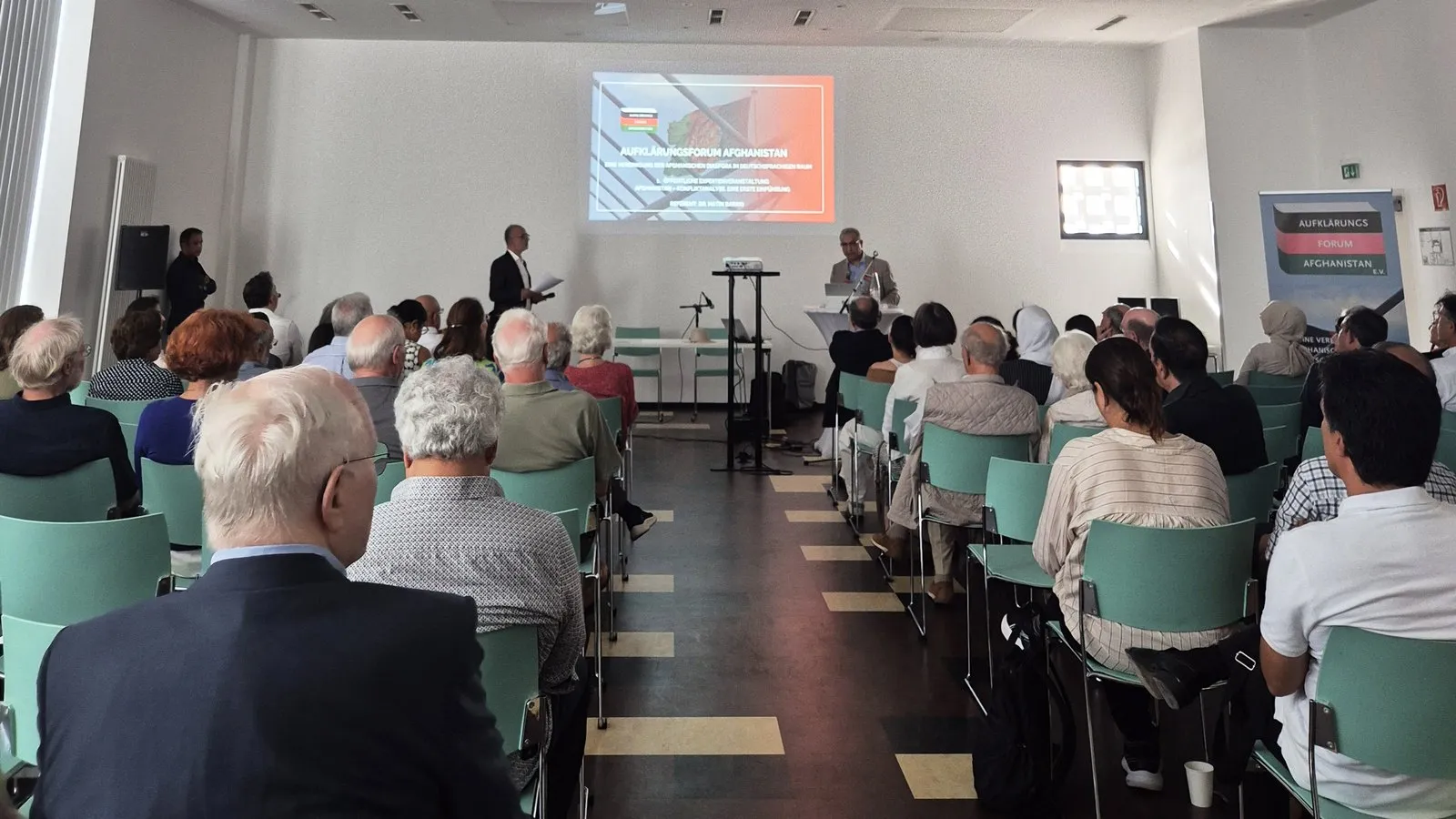
It was against this background that Aufklärungsforum Afghanistan e.V. (AfA e.V.) was founded — an association of the Afghan diaspora in the German-speaking world. The association’s aim is to inform the German and Afghan public about the political and historical context of events in Afghanistan. Dialogue with the German population, political sphere and public is a central part of this work. Drawing on its members’ many years of experience in various reconstruction processes since 1997, AfA e.V. seeks to contribute actively to cooperation, advice and coordination with other initiatives working in Germany.
Reviewing the German deployment in Afghanistan
In January 2022, the research services of the Bundestag stressed the need for a comprehensive review of the German deployment in Afghanistan. The progress achieved over 20 years was assessed as marginal and not sustainable. In retrospect it is clear that it was not only the international coalition that made serious mistakes: Afghanistan’s corrupt elites, supported by the West, bear substantial responsibility for the present misery.
No other country in the world received comparable international support over the past two decades: 85 states took part in the Afghanistan deployment, 50 of them militarily. In addition, 15 international organisations and around 1,700 non-governmental organisations (NGOs) were involved in reconstruction (Deutscher Bundestag 2022).
In February 2024, the commission of inquiry “Lessons from Afghanistan for Germany’s future networked engagement”, set up by the Bundestag in 2022, presented its interim report. German engagement between 2001 and 2021 was assessed as a fatal mixture of a lack of strategy and overly ambitious goals, combined with an ignorant absence of basic expertise regarding the political, social and historical realities of Afghanistan.
The commission, half of whose members are members of the Bundestag, criticised in particular the lack of parliamentary scrutiny on strategic and political questions. This failure entails a shared responsibility on Germany’s part for the current situation in Afghanistan.
In the commission’s second phase, concrete recommendations for the federal government’s future crisis management are to be developed on the basis of the findings obtained. The aid currently provided through UN trust funds and partner organisations alleviates the humanitarian crisis only to a limited extent, while at the same time increasing Afghanistan’s dependence on international support.
Assuming shared responsibility for Afghanistan — both now and in the future — is understood as part of a values- and interest-driven foreign policy, even where this entails high costs, sacrifices and the failure of engagement so far (Mielke and Nachtwei 2024).