AfA Today · Topic 3
Women’s Rights
On this page
- The rhetorical facade and the institutional transformation
- The “Virtue Law” and the institutionalisation of gender apartheid
- The radical restriction of movement and everyday practices
- The 2021 marriage decree and actual legal practice
- Current developments and escalations (present context 2025/2026)
- Sources
Changes since 2021
The rhetorical facade and the institutional transformation
- Equality as lip service: Shortly after the seizure of power in August 2021, Taliban spokesman Zabiullah Mujahid announced the formal equality of men and women, but at the same time qualified this by stating that women’s rights would be implemented exclusively within the framework of the Islamic legal order (bpb 2024).
- Institutional erasure: Immediately afterwards, the Ministry of Women’s Affairs was dissolved. It was replaced by the notorious Ministry of Prayer and Guidance and for the Propagation of Virtue and the Prevention of Vice (in short: the Virtue Ministry), which had already been responsible for public floggings and stonings during the first period of rule (1996–2001) (BAMF 2024b).
- Systematic legal uncertainty: The restrictions are imposed arbitrarily through speeches, social media and news broadcasts. Vague legal terms such as “violation of Sharia” are deliberately left undefined in order to allow an unpredictable, repressive interpretation (BAMF 2024b).
The “Virtue Law” and the institutionalisation of gender apartheid
The “Virtue Law”, published on 31 July 2024 and enforced to this day, established comprehensive social control over women (Tagesschau 2024):
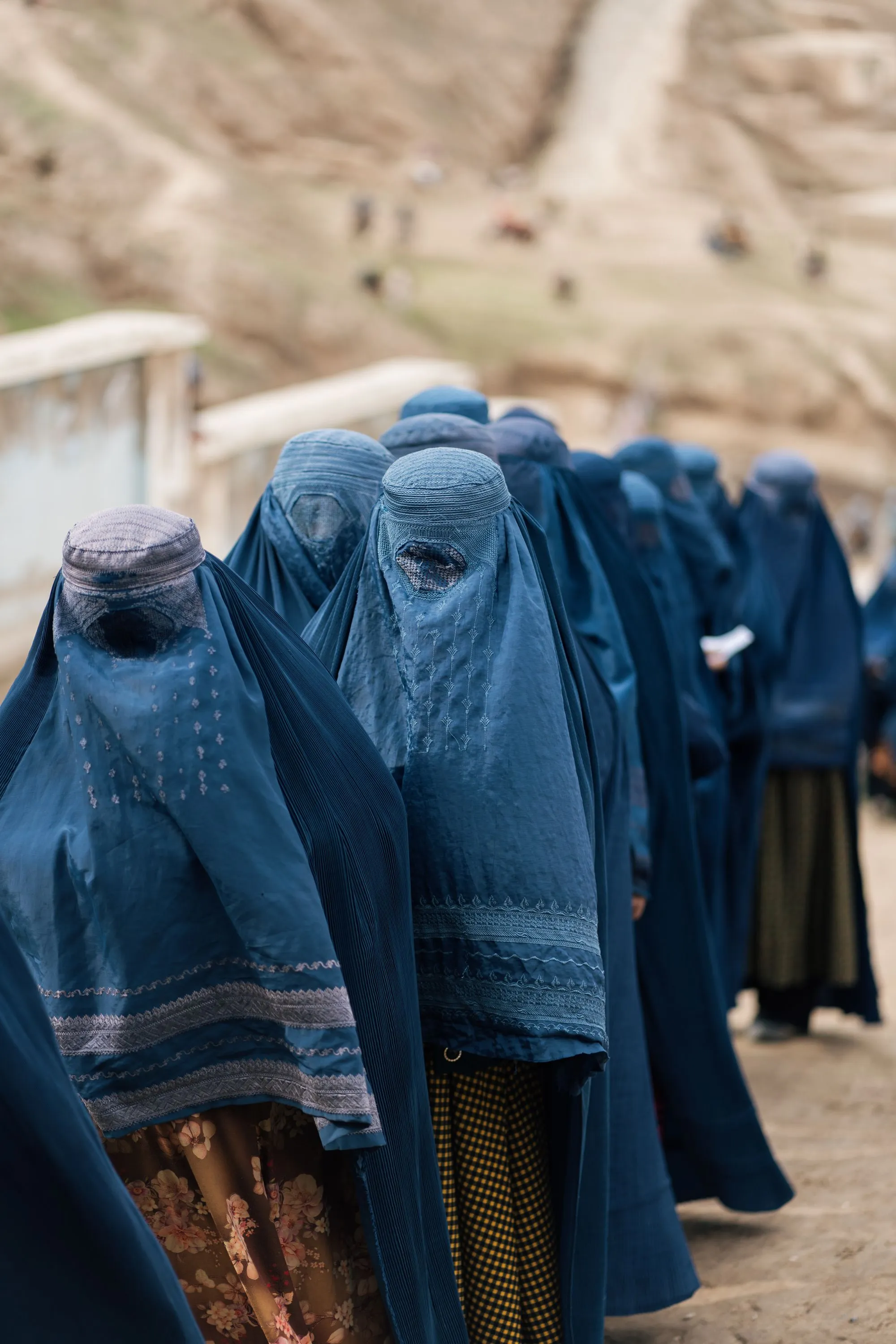
- Total covering: There is a strict obligation to cover the entire body and face. Under no circumstances may clothing be thin, short or tight. The obligation to cover applies even in front of non-Muslim women.
- Acoustic ban: In public, the female voice is regarded as Aurah (intimate part) and has been banned; singing, reciting or speaking loudly in public is prohibited (DW 2024).
- Contact ban: There is an absolute ban on contact and on looking at one another between unrelated men and women.
- Domestic captivity: Leaving the house is permitted only for compelling reasons, in silence and accompanied by a Mahram (male guardian).
The radical restriction of movement and everyday practices
- Mahram requirement and travel restrictions: Since as early as December 2021, drivers have been prohibited from transporting unveiled women. In addition, women were prohibited from travelling distances of more than 72 kilometres without a Mahram (BAMF 2024b). Since April 2022, a ban on flying without male accompaniment has been in force, followed in May 2022 by the official instruction not to leave the house at all if possible (BAMF 2024b).
- Loss of civil rights: On 5 May 2022, the issuing of driving licences to women was permanently prohibited (BAMF 2024b).
- Ban from public space: The ban on sport in September 2021 was followed in November 2022 by the complete exclusion of women from sports facilities, amusement parks and public baths (Wikipedia 2022). Displaying images of women in public is punishable.
- Sanctions: Women who disregard these rules are arbitrarily stopped, threatened, detained or tortured (BAMF 2024b).
The 2021 marriage decree and actual legal practice
The formal decree of 3 December 2021 ostensibly guaranteed women protective rights in the area of marriage (prohibition of forced marriage, prohibition of marriage of minors, inheritance rights for widows and equal treatment in polygamy). However, these provisions served primarily to appease the international community, excluded fundamental rights to education or work and were never applied in practice (BAMF 2024b).
Current developments and escalations (present context 2025/2026)
- Aggravation of the education and health crisis: To this day, the regime has unyieldingly maintained the bans on secondary and higher education for women that have been condemned by the United Nations (HRW 2025). Most recently, women were additionally prohibited from studying medicine and midwifery, which is causing medical care for women to collapse, since female patients may only be treated by women (UN Women 2026).
- Total legal disempowerment in forced marriages: New legal analyses of the de facto legislation document a dramatic increase in forced and child marriages (Amnesty 2026). Through decreed patriarchal legal mechanisms, the mere “silence” of an underage girl after puberty is regarded as automatic consent to marriage. Fathers were given absolute power to arrange marriages, while women are completely denied access to the courts (Amnesty 2026).
- Normalisation of gender apartheid: By 2026, the Taliban have issued more than 166 decrees that specifically curtail the rights of women (GIWPS 2026). The latest data show that every second Afghan woman now leaves the house at most twice a month and more than 70 per cent feel in acute danger to their lives outdoors without a Mahram (UN Women 2026).
Sources
- Amnesty (2026): Zwangsverheiratung in Afghanistan: Taliban-Gesetz festigt patriarchale Strukturen. Amnesty International Deutschland.
- BAMF (2024b): Länderreport Afghanistan: Die Situation der Frauen unter den Taliban. Bundesamt für Migration und Flüchtlinge.
- BAMF (2026): Briefing Notes KW 29/2026: Afghanistan – Durchsetzung von Tugendgesetz. Bundesamt für Migration und Flüchtlinge. bamf.de
- bpb (2024): Konfliktporträt Afghanistan. Bundeszentrale für politische Bildung.
- DW (2024): Taliban erlassen „Tugend“-Gesetz in Afghanistan. Deutsche Welle.
- GIWPS (2026): Five Years of Taliban Rule: The Normalization of Gender Apartheid. Georgetown Institute for Women, Peace and Security.
- HRW (2025): Afghanistan: Unerbittliche Unterdrückung nach vier Jahren Taliban-Herrschaft. Human Rights Watch.
- OHCHR (2025): Study on the so-called “Law on the Promotion of Virtue and the Prevention of Vice”. Report of the Special Rapporteur on the situation of human rights in Afghanistan, Richard Bennett, A/HRC/58/74. UN Digital Library
- Tagesschau (2024): Neues „Tugend“-Gesetz: Taliban führen strenges Regelwerk ein. ARD-Tagesschau.
- UN (2026): Afghanistan: UN experts warn against normalisation of Taliban rule. OHCHR press release. ohchr.org
- UN Women (2026): Five years after the Taliban takeover: the normalization of the exclusion of women and girls. United Nations Entity for Gender Equality and the Empowerment of Women.
- Wikipedia (2022): Treatment of women by the Taliban. English Wikipedia, retrieved 2026-10-20. en.wikipedia.org